The short answer: Yes, you can (and should!) strength train with osteoporosis or osteopenia. Lifting weights is one of the best tools we have to slow bone loss and keep you strong for everyday life. But it isn't the only factor. Genetics, nutrition, vitamin D, and sometimes medication all play a role. If you lose some bone as you age, even while training consistently, that doesn't mean you've failed.
If you've just heard the words "osteoporosis" or "osteopenia" at a doctor's appointment, you may have walked out feeling a little panicked. Maybe you've started second-guessing every movement: Can I still bend over? Should I avoid twisting? Is lifting weights going to hurt me?
Take a deep breath. I'm a Doctor of Physical Therapy and a board-certified orthopedic specialist, and after working with hundreds of women, here's what I want you to know first: movement is protective. A bone density diagnosis is a reason to train smart, not a reason to stop moving.
Let's talk about what strength training can do for your bones, what it can't do, and how to approach it safely at home.
Osteopenia vs. Osteoporosis: What's the Difference?
Both terms describe lower-than-typical bone density, just at different levels.
Osteopenia means your bone density is lower than average, but not yet low enough to be classified as osteoporosis. Think of it as an early heads-up.
Osteoporosis means bone density has dropped further, and bones are more vulnerable to fracture.
If you've been diagnosed with osteopenia, the main goal is to slow the progression toward osteoporosis. If you already have osteoporosis, the goal is to maintain the bone you have and prevent further loss. In both cases, strength training is a key part of the plan.
Is Some Bone Loss a Normal Part of Aging?
Yes, and this is the part I wish more women heard.
We build most of our bone in our younger years, and bone mass typically peaks in our mid-20s. After that, some gradual loss is a normal part of getting older. For women, that loss often speeds up around perimenopause and menopause, as estrogen (which helps protect bone) declines.
Here's something else that surprised a lot of my members: how much bone you build at your peak is largely driven by genetics. I recently chatted with PhD researcher Dr. Lauren Colenso-Semple in Instagram DM's, and she reinforced that genetic factors influence both how much bone you build in the first place and how predisposed you are to osteopenia or osteoporosis later in life.
So if your mom and grandmother both had osteoporosis, you may be facing an uphill climb. Strength training is even MORE essential, but having some bone loss doesn't mean you failed to do enough.
Why Strength Training Is Essential for Bone Health
Your bones are living tissue. They respond to the load you put on them. When your muscles pull on your bones during resistance training, that signal tells your body to hold onto (and protect) the bone you have.
At this stage of life, the goal of strength training usually isn't to dramatically increase bone density. While we certainly see that small improvements can happen, being able to maintain the bone density you have is a considerable win. The realistic, research-supported goal is to maintain bone and prevent future loss.
Strength training goes beyond just providing force to the bones:
Muscle mass is protective to your bones. Muscles and bones talk to one another, and having more muscles means better bones!
Better balance means you're less likely to fall in the first place. This is especially important if you're at a higher fracture risk.
Maintain independence with everyday tasks like carrying groceries, climbing stairs, or getting up off the floor.
Strength Training Isn't the Only Piece of the Puzzle
This is the key point I don't want you to miss: strength training is critical, but it isn't the ONLY factor at play.
It's not as simple as "if you train hard enough, your bones will look like they did in your 20s." Bone health depends on a whole host of things, some less in our control than others.
Genetics
As we covered above, your genes play a big role in both your peak bone mass and your risk for osteoporosis. You can't change your genetics, but you can influence everything else on this list.
Eating Enough (Seriously)
This one gets overlooked all the time, especially in our thin-obsessed society. When your body doesn't get enough fuel, it will pull resources from wherever it can, and that can include your bones. A lot of women simply aren't eating enough to support their bone health, especially after years of diet culture messaging telling them to eat less.
If you're not sure whether you're eating enough, a Registered Dietitian can be a wonderful resource.
Vitamin D, Sunlight, and Calcium
Your body needs vitamin D to absorb calcium, and calcium is a key building block of bone. Sunlight helps your body make vitamin D. Supplementation may be necessary, but lifestyle factors and nutrition may be a more bioavailable solution if supplements aren’t moving the needle.
Medication (For Some People)
Bone medications can be a useful tool, depending on the person. But Dr. Colenso-Semple emphasized something important: these medications need to be carefully managed under the direction of a doctor (often an endocrinologist), because when they aren't taken properly, they can have unwanted effects. As with any medication, there are trade offs.
You Haven't Failed If You Still Lose Bone
I want to say this clearly, because it is easy to blame yourself.
If you strength train consistently, eat a nutrient-dense diet, and still see some bone loss on your next scan, especially with a strong family history, that does not mean you failed. It likely means your training is helping you lose less than you would have otherwise.
Is It Safe to Strength Train With Osteoporosis?
For most people, yes. A diagnosis like this can create a real fear of movement, and that's completely understandable. But avoiding movement altogether can leave you weaker, less steady on your feet, and less capable in daily life.
Here's how I explained it to one of our members recently.
A Real Question From a Loa Member
A member who has been managing her bone health for 15 years reached out with questions about specific exercises. She was worried about side-lying positions and twisting, and wondered whether she should swap certain core moves. Here's part of my reply:
"Side-lying and twisting: some reassurance here. You lie on your side every night when you sleep, and that position is essentially unweighted for your spine. A side-lying exercise in class carries that same low load. It's a safe position, and your spine doesn't need to be perfectly straight to be safe.
Same goes for bending and twisting: we do those things constantly in daily life (getting in and out of a car, picking things up off the floor). Doing them in a controlled, mindful way in class is actually what keeps us capable of doing them in life."
When to Talk to a Physical Therapist
If you're still anxious, it may be worth working one-on-one with a physical therapist. A PT can review your full history, look at your fracture risk, and watch how you move so you can feel even more confident during our classes together.
What About Jumping and Impact Exercise?
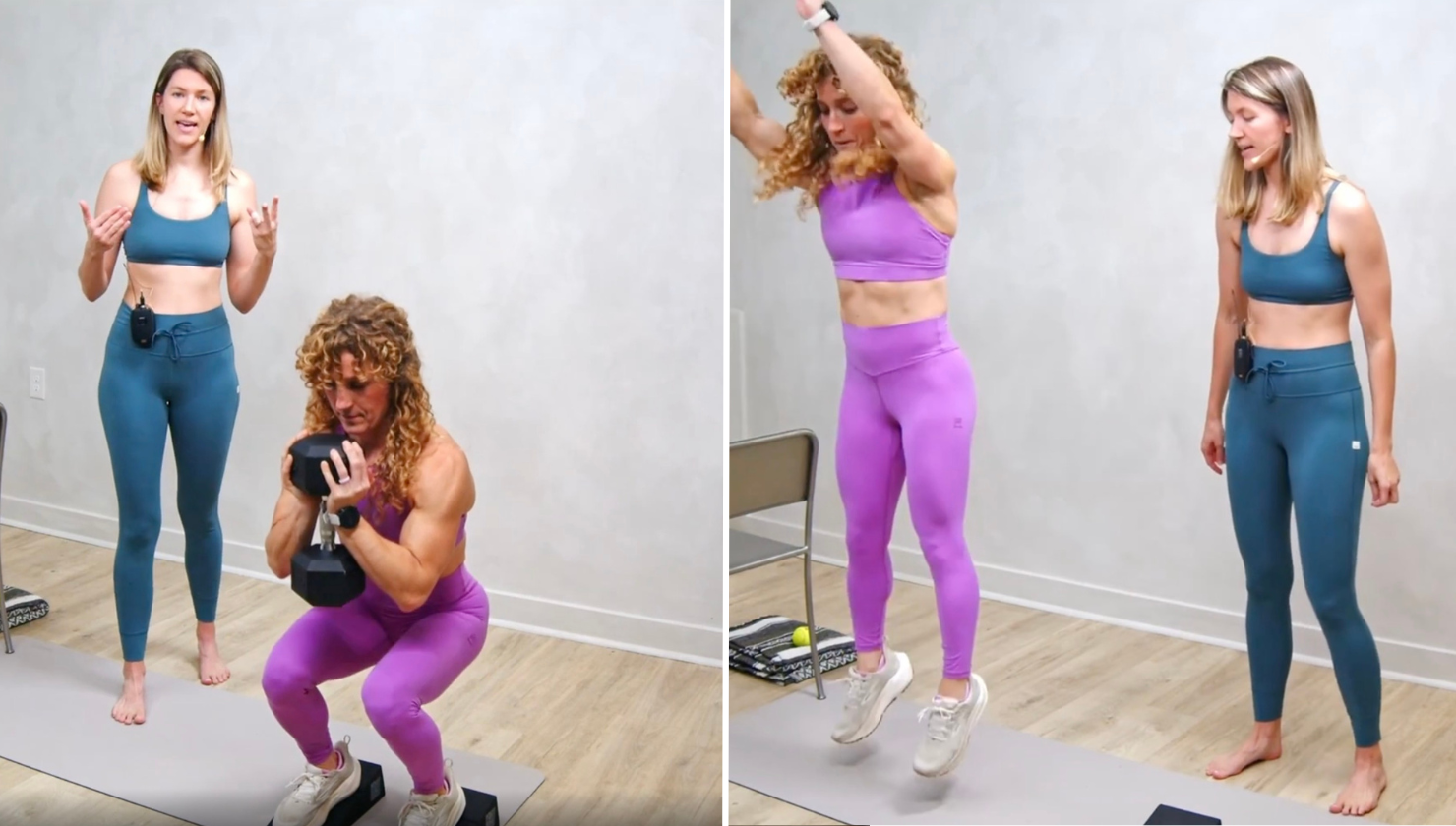
You may have seen advice to add jumping or high-impact exercise for bone health. It's a fair question, but it's not something I tend to prescribe across the board, for a few reasons:
There isn't strong evidence that jumping adds a substantial benefit ON TOP OF lifting weights.
Many women have joint pain or other issues that make jumping hard to do consistently, and consistency matters more than any single exercise.
Jumping may not be appropriate for those at higher fracture risk.
If you enjoy jumping and you're not experiencing increased pain, go for it! But remember to build up slowly. Too much too soon is a recipe for injury.
The strongest evidence is towards a "multimodal approach," meaning strength training PLUS jump training. But if it hurts or worries you, that is totally valid. Lifting weights is the foundation, the non-negotiable.
How to Start Strength Training at Home With Osteopenia or Osteoporosis
You don't need a fancy gym to get the benefits. A few guidelines that can help:
Train each major muscle group for about 3-4 sets, around 2x a week. Consistency over months and years is what protects bone.
Challenge yourself with real weight. Bone responds to load, so you want your workouts to feel genuinely challenging... but within reason so you can still show up consistently.
Progress gradually. You may notice as you get stronger that a movement feels less challenging than it did a couple months ago. Try pickup up a slightly heavier weight to continue increasing the challenge and creating strength adaptations.
Move with intention. Trying to go heavier at all costs isn't the goal. You want to make sure you can safely move with good form. If exercise is creating back pain, then we've missed the plot!
Modify freely. Swap any move that doesn't feel right for one that does. (Toe taps instead of crunches feel safer for your spine? Go for it!)
Get clearance if you need it. If you've had a recent fracture or your doctor has given you specific restrictions, follow their guidance and consider working one-on-one with a physical therapist.
How Loa Movement Supports Women With Low Bone Density
Many of our members are here specifically because they want to use strength training to support their bone health, so if that's you, you're in great company.
Loa Movement is an at-home strength training program for women, with classes led by a Doctor of Physical Therapy. Our strength training classes run Monday, Tuesday, Thursday, and Friday, with Mat Core on Wednesday. In each class, we do about two main lifts "as heavy as we can" for 8 reps, plus "higher rep, moderate weight" work, so you get real loading for your bones without feeling like you're guessing.
In every class I give modification options (or as we like to call them: "customizations") so you can train in a way that feels good to your specific body.
Ready to get stronger and protect your bones without the fear? Get started with our Free Class Sampler and train with us from home.
Want to go deeper on the science? Read our post on Strength Training for Bone Density.
Frequently Asked Questions
Can you reverse osteoporosis with strength training?
Possibly! But this can be challenging, especially later in life. The realistic goal is to maintain the bone you have and slow further loss. That's a big win, even if your scan doesn't change dramatically.
Is it safe to lift weights with osteopenia?
For most people, yes, and it's one of the best things you can do to slow the progression toward osteoporosis. If you have a history of fractures or specific restrictions, check with your doctor or a physical therapist first.
Should I avoid twisting and bending with osteoporosis?
You don't need to fear these movements. We bend and twist all day long in normal life. Practicing them in a controlled way during workouts helps you stay strong and capable. If you're at high fracture risk, work one-on-one with a physical therapist so you can train confidently.
How often should I strength train for bone health?
Aim to train each major muscle group about twice a week, with weights that feel challenging. Consistency over the long term matters most.
Do I need to do jumping exercises for my bones?
Not necessarily. While it can be beneficial, there isn't strong evidence that jumping provides much on top of lifting weights, and it may not be appropriate for everyone, especially those at higher fracture risk or with joint pain.
I strength train but still lost bone density. Did I do something wrong?
No. Some bone loss is a normal part of aging, and genetics play a big role. Your training is likely helping you lose less than you otherwise would.