The short answer: No, you don’t need to lift your absolute heaviest weight on every exercise to make progress. Muscle grows when your reps feel challenging and start to slow down, whether that’s sets of 5 reps or 20. Selecting 1–2 focused lifts per workout to target as “low reps, higher weight”, and letting the other movements be slightly “higher rep, moderate weight” allows your workouts to be adequately challenging, but sustainable. Consistency is what drives results so we need to workout in a way that allows us to keep showing up.
A Loa member recently emailed me a question I think SO many women are wondering about. With all the online pressure to track every weight, rep and set and always push harder, it’s easy to feel like you’re never doing enough. So I wanted to share our conversation.
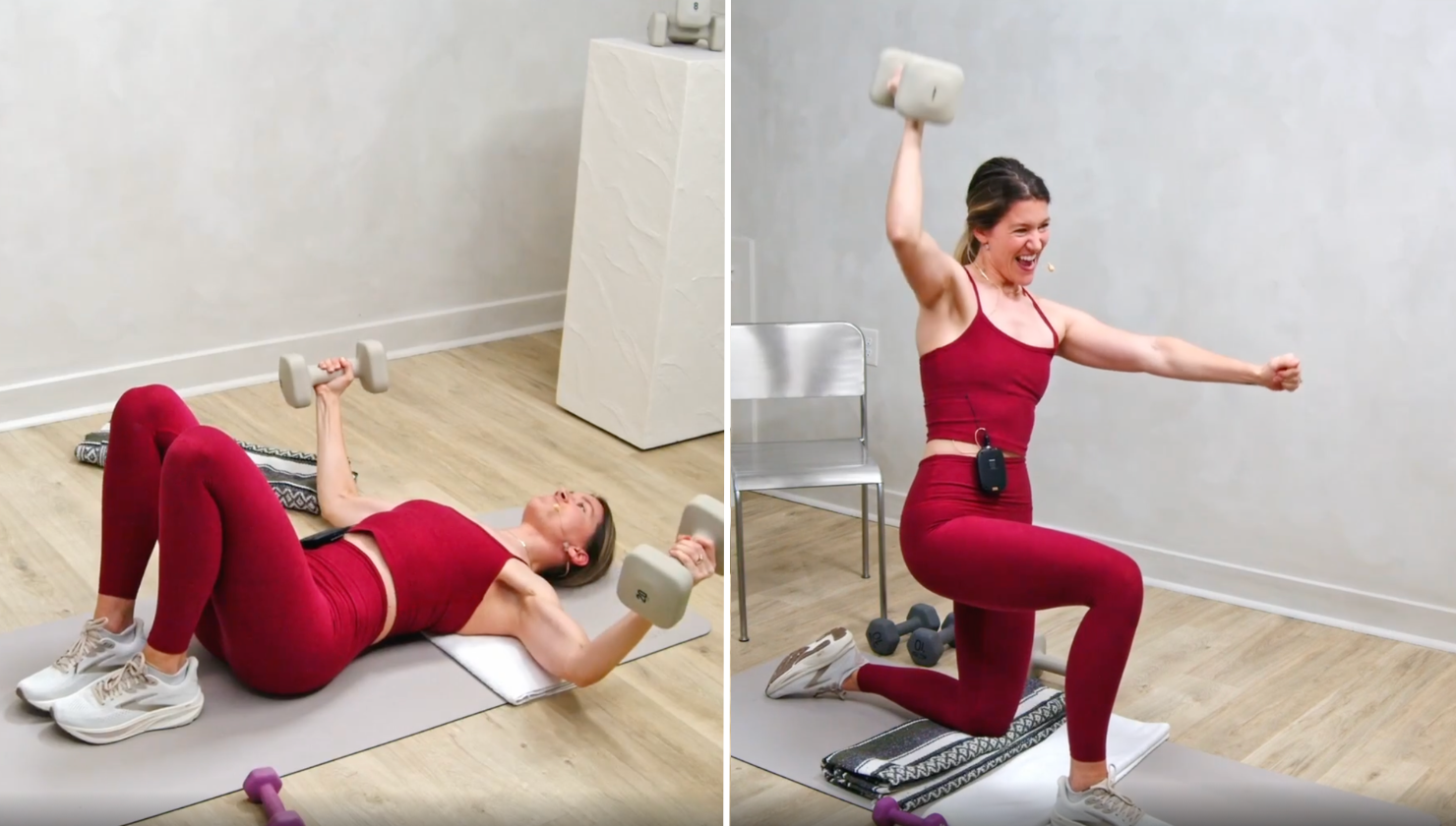
She'd noticed that in Loa classes, we don't always push for the heaviest weight possible on every move. We typically have 2 main lifts where we go “as heavy as we can” for an 8 rep set, and the rest of the movements use a slightly lighter weight for more reps.
She was loving it (and the rest / breathwork peppered in!), but with SO much talk online about progressive overload, she wanted to know: Is this really enough to make progress? And how do you balance pushing yourself with managing fatigue?
This is such a great question. So let's dig in.
Why Not Lift Your Heaviest Weight on Every Exercise?
The biggest thing I like to convey is that... we're not lab rats. Haha!
In theory, yes, you could take every single exercise to complete muscle failure, and on paper that would maximize strength gains and muscle growth.
But I can tell you from my own experience (and from working with hundreds of women) that it's incredibly challenging to show up consistently with this approach... and consistency is BY FAR the single most important factor when it comes to not only building, but maintaining muscle.
If you go all-out on your upper body on Monday, it's really hard to show up a couple days later and do it all over again. I find this especially true as we enter perimenopause and find our bodies struggling with lower energy and achier joints.
Remember, our muscles, joints and nervous systems have real limits. So even if a study says it is optimal to show up and hit failure with every single movement, how does that actually play out in real life? For YOUR specific body?
How Strength Programs Actually Work: 1–2 Focus Lifts + Accessory Moves
This is where I really love having 1–2 primary lifts, while still hitting all our muscles.
If you've ever seen how people strength train in a gym, it usually looks like one or two big lifts for the day, say 4 sets of 6–8 heavy back squats, followed by accessory work like hamstring curls or hip abductions.
You're unlikely to find someone doing five heavy barbell lifts at 85–90% of their max in a single session. (Not saying people don’t do it, but PHEW that’s a doozy of a session.)
My goal is to mimic that in our home workouts. We choose a couple moves, like a heavy goblet squat for 8 slow reps close to failure, to really push for max strength. Then we use accessory movements (think hamstrings bridges, hip abduction, reverse Nordics) to hit all your other muscle groups in a way that still build muscle, but with a slightly more “moderate weight, higher rep” strategy.
Do Lighter Weights Still Build Muscle?
Yes! And this is the key part: those other “accessory” moves are 100% still building muscle.
We're not "taking it easy." We're just altering the rep scheme so we can use a tad lighter weight, but then still work to approach muscle failure.
The research shows that you can build muscle with sets of 5 reps or sets of 20 reps, as long as the reps feel challenging by the end of the set. (If your reps slow down and feel difficult to complete, you've hit that point.)
So when you grab a slightly lighter weight for a 1-minute or 45-second set, you're still putting in the work needed to build muscle, just with a different strategy: a tad less weight, a few more reps.
That's why Loa classes mix 1-minute sets, 45-second sets and heavier 8-rep sets. The variety in weights and rep ranges is what I find drives not only results, but ALSO the consistency it takes to show up 4–5 days a week for years.
Want to go deeper? Read Light vs. Heavy Weights: Which One Is Best? and The Muscle Failure Myth: What the Research Actually Says.
How to Use Progressive Overload Without Burning Out
Progressive overload absolutely still matters. But it doesn't HAVE to come from adding weight only.
As long as the last few reps feel challenging, you're driving change, whether that's through adding weight or adding reps.
Here's how to know if it's time to go heavier:
You got to the end of the set and didn't feel a significant challenge.
Your rep SPEED was the same at the end of the set as it was at the beginning.
Either one is a good cue to go up in weight.
But don't feel pressure to completely decimate yourself. It's a balancing act... you want to be able to show up again a few days later :)
What This Means for Body Recomposition
For body recomposition, the biggest driver is pairing progressive overload WITH showing up consistently.
If your current goal is to really maximize building muscle, I'd aim for 4 strength days a week (inside Loa, that's our scheduled Monday, Tuesday, Thursday and Friday classes) which hits all of your muscles for at least 6 to 8 sets per week. (Add Wednesday’s Mat Core as a bonus to build a solid core to support your strength days.)
And a reminder: Although I firmly believe in a “health-at-every-size, non-diet” approach, nutrition is a key piece here. Everything we're discussing is about building muscle, but making that muscle more visible also involves reducing body fat, which comes down to nutrition. [Partnering with a Registered Dietitian may be helpful if this is an area where you’re needing additional guidance. As someone who personally struggled with disordered eating, my classes focus on building muscle and feeling strong, and I don’t push “fat loss” in order to be mindful of others who have this history.]
The Bottom Line
Attempting to lift your absolute heaviest on every set of every exercise is what often leads to burnout, overall (systemic) fatigue, and soft tissue issues like rotator cuff irritation, low back pain or achy knees.
I find that people get better results when they push really hard on a couple of moves and keep everything else adequately challenging, but sustainable.
Train in a way that lets you keep showing up. That's where the magic happens.
Frequently Asked Questions
Do you have to lift heavy to build muscle?
No. You can build muscle with lighter or heavier weights, anywhere from about 5 to 25 reps, as long as the last few reps feel really challenging and your pace starts to slow. Heavy lifting is most important if your specific goal is maximal strength.
Should every set be taken to failure?
No. While there’s nothing wrong with working all the way to failure, getting close, where reps feel challenging and slow down, will still build muscle but often with less fatigue and more joint comfort.
Can you do progressive overload without adding weight?
Yes. You can progress by adding reps, performing additional sets, or increasing the time of a set. The goal is that the end of the set keeps feeling challenging as you get stronger.
How do I know when to increase my weight?
If the last few reps no longer feel challenging, or you can move the weight at a fast pace for the entire set, it's likely time to go up in weight.
How many days a week should women strength train for body recomposition?
For maximizing muscle, hitting all your muscle groups 2x a week, to achieve around 6 to 8 sets per muscle group is a great target, paired with nutrition that supports your goals. If you're newer to strength training, 2 days a week is a fantastic start. Build consistency there before adding more days.
Can you build muscle with home workouts and dumbbells?
Absolutely. Using a mix of heavier focused lifts and lighter, higher-rep accessory moves, while focusing on reaching the point where each set feels hard, will build real strength and muscle at home. Here’s the equipment we use in Loa classes.
Ready to try this for yourself?
Every Loa Movement workout is led by a Doctor of Physical Therapy and built around strength that supports your real life, so you can both push hard AND show up consistently.
Want to try 3 FREE classes? No credit card required! TAP HERE!